
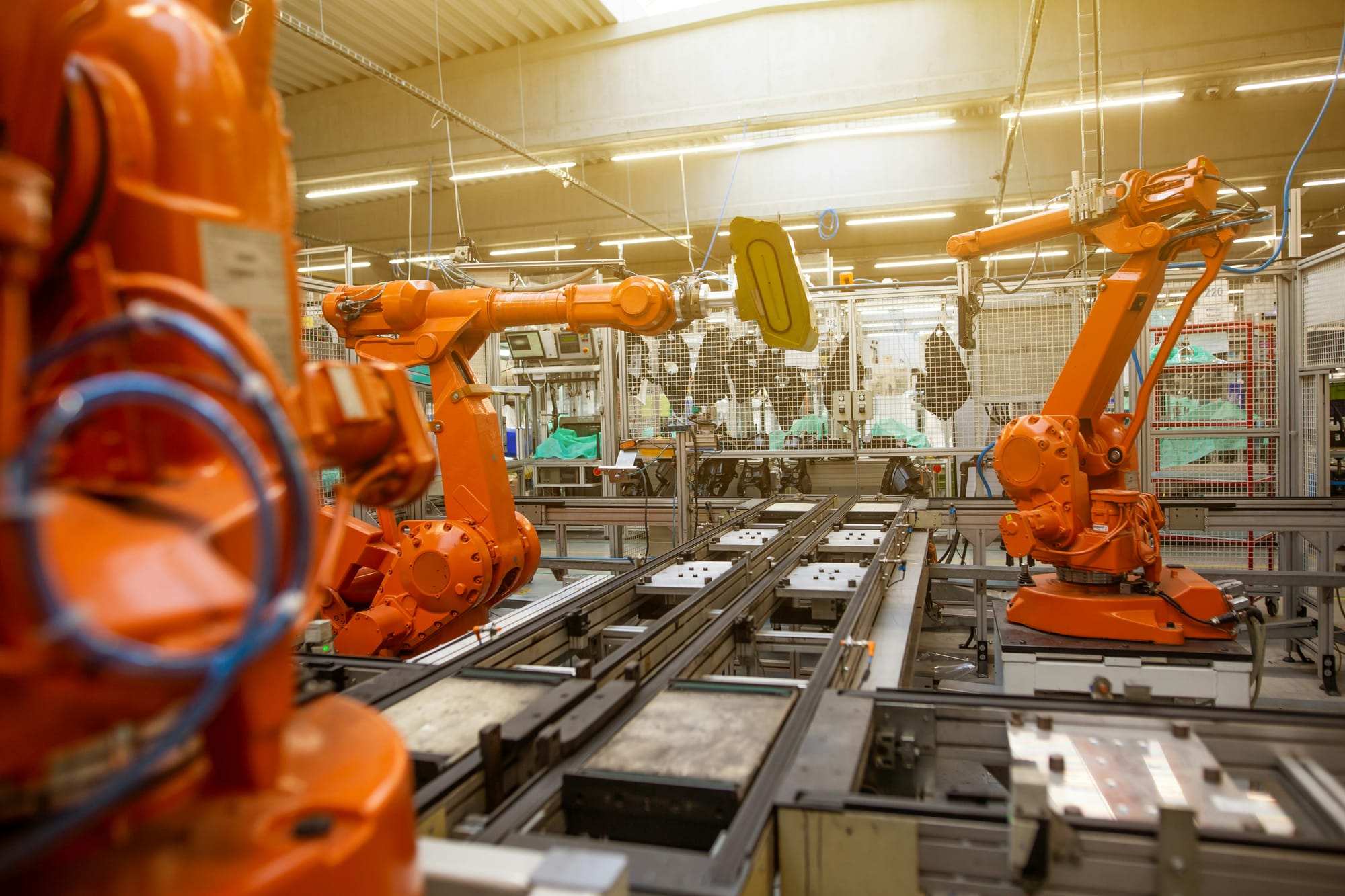
If you had to design the ideal environment for industrial AI from scratch, you’d design a factory. It’s enclosed and controlled. The lighting doesn’t change. The parts arrive in known orientations. Every machine already emits telemetry, every process already has tolerances and the whole operation is measured to a degree that would make most of us jealous: cycle time, first-pass yield, scrap rate, overall equipment effectiveness. There’s a century of process engineering behind it and a clear financial objective in front of it.
So, manufacturing should be the easy case. And in a meaningful sense it is: The results, where they land, are extraordinary. The World Economic Forum’s Global Lighthouse Network published its latest cohort in June, and the numbers aren’t marketing. Rockwell Automation’s Singapore site increased units per person-hour by 43 percent and cut defects by 35 percent. Schneider Electric took on-time delivery from 61 to 97 percent. Saudi Aramco raised production by 26 percent and equipment effectiveness by 44 percent. These are the kind of step changes that justify an entire technology cycle.
Here’s my concern: The Lighthouse Network is a curated list that, after years of running, contains 238 cases. There are many more factories than that in the world. The gap between those two facts is the most underrated problem in physical AI. A recent survey-based analysis puts it at around 70 percent of manufacturers having active AI initiatives and only about a third having moved anything past pilot into production. The reasons given aren’t about model quality. They are, in order: data fragmented across sites, with different MES versions, naming conventions and historian structures; legacy control and ERP systems with no API surface, forcing brittle middleware; workflows left unchanged, so the AI removes one bottleneck and reveals the next one downstream.
I want to reframe that list, because I think there’s a single mechanism underneath it, and it’s the same mechanism I described in the third part of this series. There, we discussed that a manipulation policy scoring 95 percent collapses below 30 percent when the scene is perturbed. Everything outside the training distribution is a cliff, not a slope. What the manufacturing data says is that the identical failure happens one level up. A defect classifier trained in plant one doesn’t transfer to plant two, because plant two hangs its cameras at a different angle, runs a different MES version, names its tags differently and has a supplier whose steel has a slightly different surface finish. Every plant is out of distribution with respect to every other plant.
That’s why the Lighthouse results are simultaneously real and unhelpful. Each of those sites is a genuine transformation, and each was achieved by rebuilding a specific site around the technology. What was built isn’t portable, because the thing that made it work was months of on-site reconciliation that doesn’t travel in the model weights. The industry keeps interpreting this as a pilot problem, as though the issue were commitment or budget, when it’s a distribution problem wearing overalls. This tells you what the actual product is, and it’s not the model.
For a startup, this cuts against the instinct to sell a platform. The winning wedge in manufacturing is one cell, one defect class, one machine type, with a payback measurable in weeks against a number the plant manager already reports. Scrap rate and unplanned downtime are ideal because nobody has to be persuaded they matter. Generalized “AI for manufacturing” is a pitch that dies in procurement, because the buyer has been sold that before and has the failed pilot to prove it.
But the wedge is only the entry. The compounding asset is the normalization layer: whatever you build to reconcile plant two with plant one. If your second deployment costs 80 percent of what your first one cost, you don’t have a software business, you have a consultancy with a model attached. That ratio, deployment cost two over deployment cost one, is the single most diagnostic number in an industrial AI company, and it’s the one I would ask for before any capability demonstration. Your second customer is the real test. Your first proves nothing except that the technology works somewhere.
There’s a second, less obvious opportunity here. Deloitte and the Manufacturing Institute project roughly 1.9 million manufacturing positions going unfilled over the decade to 2033, against a need for about 3.8 million new employees. Set aside the labor substitution reading for a moment and note the deployment consequence: There aren’t enough integration engineers to install this technology at the rate the market wants it. Tooling that lets one integrator do the work of three is a business with no dependency on which model wins.
For large incumbents, the calculus inverts again, and in manufacturing, it inverts further in their favor than anywhere else in this series, provided they get the sequence right. Standardize the telemetry first. Buy the AI second. A manufacturer running forty plants with forty historian schemas has, in effect, forty separate companies from a model’s point of view, and no vendor can fix that from the outside. Every euro spent on tag naming, data contracts and consistent instrumentation raises the return on every AI euro spent afterward, and unlike the AI itself, it doesn’t depreciate when the next model generation arrives. This is deeply boring work. It’s also the whole game, and the companies that have done it are the ones on the Lighthouse list.
The strategic asset is again the installed base, but with a difference worth noting. When I argued that robot manufacturers risk being disintermediated at the intelligence layer, the analogy was handset makers losing value to the operating system. Process manufacturers are better positioned than that, because what they hold isn’t just machines but process knowledge: why this weld fails at this humidity, which supplier’s material drifts, what the operator does at 3 AM that keeps the line running. That knowledge isn’t on the internet and can’t be scraped. It is, however, mostly in people’s heads and mostly undocumented, which means it is one retirement wave away from being lost. Capturing it is an AI project only in the sense that AI is what finally makes it worth doing.
For society, the factory is the least visible and most consequential deployment in this series. There will be no photo opportunity. After the argument, made in the previous part, about regulating the silhouette rather than the capability, this is the other side of it: The machines actually restructuring industrial work don’t look like anything, and they’ll attract a fraction of the attention that a walking robot gets for 1,250 hours of pilot work.
The employment story is real but more textured than the headline. The Deloitte data suggests the binding constraint in manufacturing is finding people, not shedding them, and that the roles are shifting rather than vanishing: fewer operators watching a process, more technicians maintaining the systems that watch it, with demand for simulation skills up 75 percent in five years. That’s a retraining problem, and retraining problems are solvable in a way that mass displacement is not, provided anyone funds them at the necessary scale. Whether that happens is a policy question rather than a technology one.
There’s also something the software industry should be humble about here. Throughout this series, I’ve argued that the durable artifact is becoming the contract a system must honor plus the running evidence that it does. On a factory floor, that’s not a proposal. A plant already knows its yield, its scrap rate, its tolerance bands, its OEE, and it already treats a drift in any of them as an event requiring explanation. The shop floor solved continuous evaluation decades before our industry noticed it had the problem. When we work out how to evaluate learning systems properly, the answer is going to look a lot more like statistical process control than like a test suite.
Which brings me to the thing I can’t stop noticing about industrial AI as it’s actually deployed. The single most common application on factory floors today is automated visual inspection: cameras and models at the end of the line, catching defects before they ship. It works, the ROI is clean and I understand entirely why it’s where everyone starts.
But William Edwards Deming told us what to think about this in “Out of the crisis” in 1982, as the third of his fourteen points: “Cease dependence on inspection to achieve quality. Eliminate the need for inspection on a mass basis by building quality into the product in the first place.” We’ve taken the most powerful technology of our era and pointed it, first and hardest, at the activity Deming spent his career telling us to stop depending on. Catching more defects is worth doing. It’s not the prize. The prize is a process that doesn’t produce them. And getting there requires the models to move upstream, into the parameters and the setpoints and the supplier decisions, where the causes live rather than the symptoms. That’s a harder sale, a longer payback and a much larger number. It’s also the only version of this that Deming would have recognized as improvement.
Next in the series: Machines on the Move — autonomous vehicles and logistics, and what the longest-delayed promise in the field actually taught us.
Want to read more like this? Sign up for my newsletter at jan@janbosch.com or follow me on janbosch.com/blog, LinkedIn (linkedin.com/in/janbosch) or X (@JanBosch).